Ethnoarchaeology is the study of living cultures through archaeological methods. It is a modern sub-discipline of anthropology that studies the past through the present in order to better understand the dynamics of today's cultures. Ethnoarchaeology is often used in conjunction with other archaeological methods such as excavations and surveys to gain further insight into ancient cultures and to further explain the present.
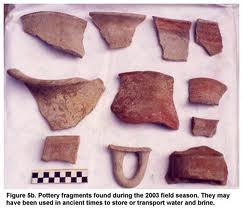
The main focus of ethnoarchaeology is to study the material culture of living people and how it relates to archaeological evidence. This includes examining how individuals make, use, and discard objects. For example, an ethnoarchaeologist may study how a particular group of people use pottery, stone tools, or other objects.
They might also look at how particular objects are used in rituals or religious ceremonies. By studying living cultures, ethnoarchaeologists are able to gain insight into the culture and behavior of ancient people.
Another important aspect of ethnoarchaeology is the use of ethnography. Ethnography is the study of people's beliefs, practices, and customs. Ethnoarchaeologists may use ethnography to gain insight into how a particular group of people interact with their environment and use material culture.
This type of research can provide valuable information about the meanings and functions of ancient artifacts and the behavior of ancient cultures.
Ethnoarchaeology is an important tool for understanding the past. It can provide archaeologists with invaluable insights into ancient cultures and help to explain how certain artifacts were used in the past. It can also provide insights into how ancient cultures interacted with their environment and the ways in which they used and transformed material culture. By studying the living cultures of today, archaeologists can gain a better understanding of the past and help to reconstruct past cultures.
Archaeology and Traditional Knowledge: A Cross-Cultural Perspective
Archaeology and traditional knowledge have evolved side by side for centuries, forming a long and intertwined relationship. Archaeology is the scientific study of the human past, based on the physical remains of human activity.Traditional knowledge is thecollective wisdom held by a group of people, passed down through generations orally and through other forms of communication.
Archaeology has benefited greatly from traditional knowledge, particularly when it comes to understanding how ancient cultures lived. For instance, Indigenous peoples often have an intimate knowledge of their ancestral lands, which can provide invaluable information to archaeologists.
This knowledge can help provide insight into how and why certain archaeological sites were built, as well as the lives of those who built them.
Traditional knowledge can also help archaeologists to interpret their findings. For instance, Aboriginal Australians may be able to provide insight into the meaning behind certain artifacts and features found at archaeological sites. This can be invaluable when it comes to understanding the cultural practices of the cultures that built them.
Traditional knowledge can also provide insight into how ancient cultures interacted with their environment. Indigenous peoples often have a deep understanding of the land, which can help archaeologists to understand how ancient cultures used resources and adapted to changing environmental conditions.
Archaeology has also had an impact on traditional knowledge. For instance, archaeological research can provide evidence for stories and beliefs held by Indigenous peoples. This can help to validate traditional knowledge and give it greater credibility.
A cross-cultural perspective is essential in order to fully appreciate the importance of traditional knowledge and its relationship with archaeology. It is only through collaboration between archaeologists and Indigenous peoples that the full potential of both disciplines can be realized. By working together, archaeologists and traditional knowledge holders can build a better understanding of the past, and ensure that both are respected and valued.
Gordion Ethnoarchaeology Project as a component of the Gordion Excavations
The Gordion Ethnoarchaeology Project is a component of the Gordion Excavations which studies the traditional uses and activities that have taken place in the Gordion region since the Iron Age. The project utilizes a combination of archaeological, historical, ethnographic and experimental approaches to explore the cultural relationships between ancient and modern inhabitants of the region. The project seeks to understand the ways in which local communities have interacted with their environment over time, and how these interactions have shaped the cultural landscape of the region.
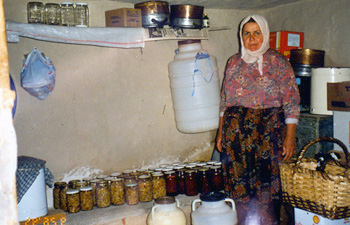
Traditional food preparation and storage techniques vary greatly between cultures. Generally, these techniques involve drying, salting, fermenting, pickling, smoking, and preserving foods for later use. These methods can help preserve nutrients, improve flavor, and extend the shelf life of food. In some cultures, food is cooked in clay pots and buried in the ground, allowing for slow, even cooking. In other cultures, foods are left to dry in the sun or stored in containers made of terracotta, wood, or metal. Overall, traditional food preparation and storage techniques are an effective way to ensure the longevity of food and its nutritional value.
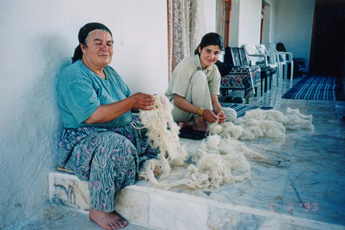
Wool processing is a complex process that begins with shearing the wool from the sheep. The raw fleece is then sorted, washed, and dried. Next, the wool is carded, which removes dirt and oils, and aligns the fibers. The carded wool is then combed, which further straightens and aligns the fibers, and then spun into yarn using a spinning wheel. The yarn is then woven into fabric, or knitted into garments. Finishing processes such as felting, fulling, and dyeing can then be applied to the fabric or garments, to give them a smooth and finished look.
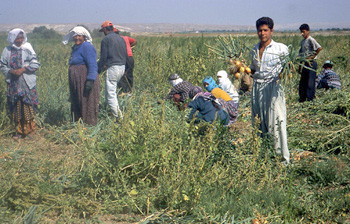
Migrant seasonal workers harvesting crops at Yassihoyuk are essential to the local agricultural industry. Every summer, these hardworking individuals arrive to help with the harvest of a variety of crops, such as tomatoes, potatoes, and melons.
The workers arrive in Yassihoyuk from all over the world, including countries such as Mexico, India, and Thailand. They have made the long journey to help bring in the harvest and support their families.
The work is hard, with long hours spent in the hot sun picking and packing fruits and vegetables. Nevertheless, the workers are driven by their commitment to providing for their families and are determined to make the most of the season.
The migrant workers have become an integral part of Yassihoyuk's agricultural industry. They help to ensure that the crops are harvested in a timely manner, allowing local producers to bring their products to market. In addition, the migrant workers help to create an atmosphere of diversity and inclusion in the community.
The migrant seasonal workers harvesting crops at Yassihoyuk are a vital part of the local economy. They come from all over the world to help bring in the harvest and provide for their families. Their hard work and dedication are an inspiration to us
The method of ethnoarchaeological interpretation
Ethnoarchaeology is the study of contemporary social and material culture in order to gain a better understanding of the past. It is used to reconstruct and interpret archaeological evidence, such as site formation processes, material culture, and past human behavior and activities. The method of ethnoarchaeological interpretation focuses on the study of living communities and cultures in order to gain an understanding of the archaeological record. Ethnoarchaeological interpretations are based on the premise that certain behaviors and activities are universal among humans and that the material culture produced as a result of these activities is similar across time and space.
The main goal of ethnoarchaeological research is to draw parallels between the material culture of contemporary societies and that of the past. Through direct observation of living communities, researchers seek to develop insights into the processes that create archaeological evidence. The method of ethnoarchaeological interpretation involves carefully observing a contemporary society and its material culture in order to understand the past.
When conducting ethnoarchaeological research, researchers must consider the cultural context of the community being studied. It is important to understand the cultural values, beliefs, and practices that shape the material culture of the society and the behavior of the individuals within it. In this way, researchers are able to gain a better understanding of the processes that created archaeological evidence in the past and their effects on the material remains.
Archaeology Pushed Aside
Archaeology is often pushed aside in favor of more popular scientific disciplines in the modern world. This is likely due to a combination of factors, including the scarcity of available funding for archaeological studies, the limited public awareness of the field, and its association with fringe theories and beliefs.
The lack of financial support for archaeology is a major obstacle to its development. Governments and institutions often prioritize more "high-profile" scientific disciplines such as physics and astronomy, which can attract more funding from donors and research grants. By contrast, archaeology often receives less support, which limits the resources and personnel available for its advancement.
Another factor that contributes to the sidelining of archaeology is its limited public awareness. People tend to be more familiar with disciplines such as biology and chemistry, which are discussed more frequently in the media. Archaeology, on the other hand, is often overlooked and not widely talked about, even though it is an important field of study.
Going it Alone
Ethnoarchaeology is a sub-discipline of archaeology that studies living cultures to help interpret archaeological remains. It is used to examine how people interact with their environment and the resulting material remains. Going it alone in ethnoarchaeology requires a great deal of preparation and research.
First, it is important to determine what kind of information is needed from the study. This will help narrow down the focus of the research and the methods to be used. It is also important to consider the ethical implications of the research, such as obtaining permission from the people being studied and obtaining informed consent.
Second, a research plan should be developed. This should include a timeline, research questions, and methods of data collection. It is important to consider how the data will be gathered and analyzed.
When the Evidence is Slim
Ethnoarchaeology is a form of archaeological research that utilizes methods of cultural anthropology in order to study the material remains of past societies. It is based on the idea that the material remains of a culture can provide insight into their behavior and beliefs. This type of research is especially useful when there is limited archaeological evidence available.
When evidence is slim, ethnoarchaeology can provide valuable information about past societies. By studying contemporary societies, archaeologists can gain insight into how ancient cultures may have behaved. Through interviews, observations, and participant-observation studies, archaeologists can learn about the material remains of past societies.
For example, by studying the subsistence strategies of modern hunter-gatherer or pastoralist societies, archaeologists can gain insight into the subsistence strategies of prehistoric societies.
By comparing the material remains of modern and past societies, archaeologists can gain a better understanding of the cultural and economic context of past societies.
Ethnoarchaeology can also provide insight into aspects of past societies that are not directly related to material remains. For instance, ethnoarchaeology can provide insight into social and political structures, religious beliefs, and cultural practices. By studying living communities, archaeologists can gain insight into how past societies may have functioned.
Supported by the Archaeological Record
Ethnoarchaeology is the study of archaeological remains through the direct observation of modern living cultures. It is a unique type of cross-cultural research that combines archaeological methods and anthropological fieldwork. The aim of ethnoarchaeology is to gain insight into the past by studying and comparing present-day cultures.
The archaeological record provides an invaluable resource for ethnoarchaeology.
By studying artifacts, archaeologists can infer aspects of past cultures, such as subsistence strategies, technological advances, and social organization. Ethnoarchaeologists use the archaeological record to observe patterns in the artifacts of modern cultures that may be linked to past behavior.
In addition to artifacts, the archaeological record also includes other evidence of past cultures, such as stratigraphic deposits, architecture, and ecofacts. Ethnoarchaeologists use this evidence to trace the development of cultural features over time and to compare and contrast the archaeological remains of different cultures.
A Legitimate Aid in Archaeological Science
Ethnoarchaeology is a field of archaeological science that investigates the archaeological record through the study of living cultures. It uses ethnographic methods—such as participant observation, interviews, and surveys—to examine how people today use, create, and discard material culture. The aim of ethnoarchaeology is to gain a better understanding of the archaeological record by studying the behavior and practices of living people.
The primary goals of ethnoarchaeology are to identify general, culture-independent laws of behavior that govern the formation of the archaeological record and to document how people use various techniques to modify their environment and material possessions.
Ethnoarchaeologists study the relationships between material culture and behavior, ecology and economy, gender roles, and the use of space.
The most common method used in ethnoarchaeology is participant observation. By living with a community and observing their everyday behavior, ethnoarchaeologists gain invaluable insights into the ways in which people interact with their material culture. Ethnoarchaeologists also use interviews and surveys to gain quantitative data about the archaeological record.
In addition to providing a better understanding of the archaeological record, ethnoarchaeology offers important insights into living cultures that may be overlooked in traditional ethnographic studies.
Ethnoarchaeology is an anthropological approach to the archaeological study of past societies. It is a field of archaeological research that uses ethnographic techniques to understand past cultural practices. Ethnoarchaeology involves the study and comparison of living cultures and archaeological sites in order to gain insight into the behavior and lifeways of ancient cultures. It is a type of archaeological research that focuses on the relationships between material culture, social behavior, and technology. This approach is used to better understand the behavior and practices of past societies, as well as to make predictions about the future of archaeological research. Ethnoarchaeology also allows archaeologists to study the current behaviors of living cultures in an attempt to gain greater insight into past ones.
About Ethnoarchaeology :
Ethnoarchaeology is an interdisciplinary field of study that combines archaeological and ethnographical methods to explore the material culture of contemporary societies. This field of study seeks to understand how past populations created and used artifacts and how their material culture can inform our understanding of the present.
Diciplines by Regional study
African Archaeology is the study of the history and prehistory of the African continent, as well as its societies and cultures, through the use of archaeological evidence. African Archaeology covers a broad range of topics, from the Stone Age to the present day.
American Archaeology also known as New World archaeology, is the study of the archaeological history and prehistory of the Americas. It is a subfield of archaeology, the study of the human past, which seeks to understand societies and cultures by examining their material culture, such as artifacts and ruins.
European Archaeology
is the scientific study of the material remains of past cultures and societies in Europe, from the Paleolithic period to the present day. It is an interdisciplinary field which draws on the methods and theories of a range of disciplines, including history, anthropology, art history, geography, geology and linguistics.
Medival archaeology is a field of archaeology that is primarily concerned with the material remains of the Middle Ages, which is roughly defined as the period from the 5th to the 15th century.
Near Eastern Archaeology is the study of the material culture found in the Near East, a region of Eurasia that covers the Middle East, North Africa, and parts of Central Asia. The region is often referred to as the cradle of civilization, as it is the site of some of the earliest known civilizations, including the Sumerian, Babylonian, and Assyrian empires.
Post Medieval Archaeology is the study of the period from the 15th century to the 19th century. It is a period of great change and transformation, with the rise of nation states, the onset of industrialization and the spread of global trade. Archaeological evidence from this period reflects the development of these changes and the impact they had on everyday life.
Modern Archaeology is the study of human activity in the past using the material remains of a culture. It is a subfield of anthropology that includes the study of artifacts, architecture, landscapes, and cultural landscapes. It is a scientific approach to the study of past cultures and societies, and often involves excavation, laboratory analysis, and other research method