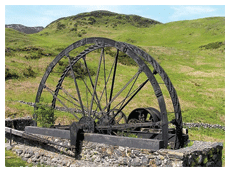
Industrial archaeology , like other branches of archaeology, is the study of material culture from the past, but with a focus on industry. Strictly speaking, industrial archaeology includes sites from the earliest times to the most recent.
Industrial archaeologists aim to record and understand the remains of industrialisation, including the technology, transport and buildings associated with manufacture or raw material production. Their work encompasses traditional archaeology, engineering, architecture, economics and the social history of manufacturing/extractive industry as well as the transport and utilities sector.
Industrial archaeologists
Industrial archaeology is the recording, study, interpretation and preservation of the physical remains of industrially related artifacts, sites and systems within their social and historical contexts. This research emphasis began after World War II as the retooling of industry began to destroy elements of an earlier industrial heritage. Industrial Archaeology has in recent years included "dirt" archaeology in addition to historical research and the above ground study of exposed structures and machinery. Its subject matter covers the industrial spectrum from bridges to factories to waterpower canals to railroads to flour mills to blast furnaces to mines to dams to workers' housing to name a few.
The Industrial Archaeology contains sites of interest to industrial archaeologists and industrial historians. Anyone with suitable web content is welcome to join the ring.
The Nizhny Tagil Charter was adopted by The International Committee for the Conservation of the Industrial Heritage at its XII Congress in Russia in 2003, and is the international standard for the study, documentation, conservation and interpretation of the industrial heritage.
Many university archaeology departments include the industrial period in their degree courses. Dedicated industrial archaeology and industrial heritage courses are usually at post-graduate level.
There are national industrial archaeology societies in many countries: the Society for Industrial Archeology (SIA) in North America, the Association for Industrial Archaeology (AIA) in Great Britain, CILAC in France, and the Italian AIPAI are among the largest. They bring together people interested in researching, recording, preserving and presenting industrial heritage. Industrial architecture, mineral extraction, heritage-based tourism, power technology, adaptive re-use of industrial buildings and transport history are just some of the themes that could be investigated by society members.
Archaeology Organizations :
Organization Name : Association of Environmental Archaeology
Established Year : 1995
Country : Romania
The AEA promotes the advancement of the study of human interaction with the environment in the past through archaeology and related disciplines. We hold annual conferences and other meetings, produce a quarterly newsletter for members, and publish our conference monographs.AEA membership is open to all those actively involved or interested in any aspect of environmental archaeology.
Organization Name : Association for Industrial Archaeology
Established Year : 1976
Country : United Kingdom
The AIA is the national organization for people who share an interest in Britain's industrial past. It brings together people who are researching, recording, preserving and presenting the great variety of this country's industrial heritage.
Organization Name : Archaeological Institute of America
Established Year : 1879
Country : United States
The Archaeological Institute of America promotes a vivid and informed public interest in the cultures and civilizations of the past, supports archaeological research, fosters the sound professional practice of archaeology, advocates the preservation of the world's archaeological heritage, and represents the discipline in the wider world.
Organization Name : Biblical Archaeology Society
Established Year : 1974
Country : United States
The Biblical Archaeology Society (BAS) was founded in 1974 as a nonprofit, nondenominational, educational organization dedicated to the dissemination of information about archaeology in the Bible lands. BAS's flagship publication is Biblical Archaeology Review.
Organization Name : Council for British Archaeology
Established Year : 1944
Country : United Kingdom
In London alone more than 50 acres of the City lay in ruins awaiting redevelopment, while the historic centres of Bristol, Canterbury, Exeter, Southampton, and many other towns had suffered devastation.
Organization Name :CILAC
Established Year : 1979
Country : FRANCE
Organization Name : IHAI
Established Year : 1989
Country :west virigina university, Morgantown
Books on the Industrial archaeology :
Industrial archaeology: principles and practice - Marilyn Palmer, Peter Neaverson - 1998.
This volume is an indispensable and up-to-date guide for undergraduates and postgraduates in archaeology and heritage management, and will be an essential handbook for those working in planning departments, and contract archaeologists..
Industrial archaeology: future directions- Eleanor Conlin Casella, James Symonds, Theoretical Archaeology Group (England). Conference - 2005.
The essays in this book are adapted from papers presented at the 24th Annual Conference of the Theoretical Archaeology Group, held at the University of Manchester, in December 2002.
Twentieth century industrial archaeology:- Michael Stratton, Barrie Stuart Trinder - 2000.
The book is well illustrated with superb and unique illustrations drawn from the archives of the Royal Commission on the Historical Monuments of England.
Rich Resources over the web on Industrial archaeology
Industrial archaeology, like other branches of archaeology, is the study of material culture from the past, but with a focus on industry. Strictly speaking, industrial archaeology includes sites from the earliest times (such as prehistoric copper mining in the British Peak District) to the most recent (such as coal mining sites in the UK closed in the 1980s).
Introduction to Archaeozoology :Industrial archaeology Industrialization is probably the most significant technological change since the development of the first stone tool. Industrialization has brought about social change on an unprecedented scale in an unbelievably short period of time. Industrialization has had such a profound effect on our lives that virtually everything we do has been influenced by it.
Diciplines by Regional study
African ArchaeologyAfrica has the longest record of human activity of any part of the world and along with its geographical extent; it contains an enormous archaeological resource. Scholars have studied Egyptology for centuries but archaeologists have only paid serious attention to the rest of the continent in more recent times.
American ArchaeologyArchaeology of the Americas is the learning of the archaeology of North America, Central America (or Mesoamerica), South America and the Caribbean, which is to say, the pre-history and Pre-Columbian history of Native American peoples.
European ArchaeologyIn terms of area, Europe is the world's second smallest continent, with an area of 10,400,000 kmē (4,000,000 square miles), making it slightly larger than Australia.
Medival archaeologyThe period covers the commotion caused by the fall of the Medival archaeology Roman Empire and cultures such as the Vikings, Saxons and Franks.
Near Eastern ArchaeologyNear Eastern Archaeology is a wide generalised application, and is divided into further regional sub-branches, the archaeology of modern states in the region or along broad thematic lines.
Post Medieval ArchaeologyThe Post Medieval Archaeology is considered as a bi-annual journal study of the material evidence of European society. This period saw the conversion of medieval to industrial society.
Modern ArchaeologyIn contrast to the antiquarianism of classical archaeology, anthropological archaeology today is concerned with culture history (i.e., the chronology of events and cultural traditions) and the explanation of cultural processes.