Ekron Inscription
Archaeology Review»
Archaeological Discoveries»Ekron Inscription
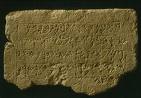
The Ekron inscription is a royal inscription written on a stone pillar, found in the remains of the ancient Philistine city of Ekron, located in modern-day Israel. The inscription dates to the 8th century BCE and is written in a dialect of early Hebrew. It is one of the few examples of early Philistine writing. The inscription is thought to have been composed by a king of Ekron, and is believed to commemorate a military victory. The exact contents of the inscription are not known, as the text is incomplete and only a few words have been deciphered.
The inscription consists of two vertical lines of text written on a limestone block. The first line reads: "K[ing] Aḥim[a]a[z]", while the second line reads: "victory of the Ekron[ites]". The words "victory" and "Ekronites" are the only words that have been definitely identified in the inscription. The first line likely contains the name of the king, and the second line may refer to a military victory of some kind. It is not known who the king was, nor what the victory was specifically.
The Ekron inscription is an important archaeological discovery, as it provides a rare example of Philistine writing and offers insight into the culture and history of the ancient Philistines. The inscription is currently on display at the Israel Museum in Jerusalem.
The Impact of Ekron on the Ancient Near East :
The city of Ekron was an important center of power and culture in the ancient Near East. It was located in the southern coastal region of modern-day Israel, in a region that was part of the Philistine pentapolis. Founded in the 13th century BCE, Ekron was an important trade hub that connected the Mediterranean Sea with inland regions. This gave it a strategic advantage, allowing it to be a major center of commerce and culture.
In the early years of its existence, Ekron was under the control of the Philistine pentapolis. It was a city-state with its own laws and customs. It was also a major religious center, with its own temple dedicated to the god Baal-Zebub. This temple attracted many pilgrims from all over the ancient Near East, and as a result Ekron gained considerable wealth and influence.
Throughout its history, Ekron was a major player in the politics of the ancient Near East. It was often in conflict with its neighbors, particularly the kingdom of Judah. In the late 8th century BCE, Ekron was conquered by the Assyrian Empire and its political autonomy was significantly reduced. This marked the beginning of a period of decline for Ekron, as it gradually faded from the political landscape of the region.
Despite its decline, Ekron still had a profound impact on the ancient Near East. Its temple and its status as a major center of trade and culture helped to spread the worship of Baal-Zebub throughout the region. This influence was felt even in distant regions such as Egypt, where the worship of Baal-Zebub was adopted by some pharaohs. The city of Ekron also had a major impact on the development of the Hebrew language, as it was a major center of trade for the region. Finally, Ekron's strategic location meant that it was an important factor in regional politics for centuries.
The Use of Ekron Inscriptions in Biblical Studies :
- The Ekron inscriptions are a collection of ancient texts discovered in the ruins of the ancient Philistine city of Ekron (modern-day Tel Miqne). These inscriptions, written in a script known as "Old Canaanite" and dating from the 9th–6th centuries BCE, provide invaluable insights into the history and culture of the ancient Near East.
- In particular, they are an important source of information on the Philistines, an ancient people who are mentioned in the Bible but are otherwise largely unknown.
- The Ekron inscriptions are particularly significant for biblical studies because they provide evidence of the Philistine presence in the region during the Iron Age. This evidence is especially helpful in understanding the context of some of the events described in the Bible, such as the Philistine conquest of Israel in the 12th century BCE and the subsequent Philistine defeat at the hands of the Israelites in the 11th century BCE.
- The inscriptions provide evidence of the religious practices of the Philistines, which are often compared to those described in the Bible.
- The Ekron inscriptions can help scholars to better understand the language and writing system used in the biblical texts. For instance, some of the inscriptions contain words and phrases that are similar to those found in the Bible, which can be used to compare the two languages and writing systems.
- The Ekron inscriptions provide important evidence for the study of other ancient Near Eastern cultures. For example, they contain references to other ancient Near Eastern peoples, such as the Hittites and the Assyrians, which can help scholars to better understand the political and economic relationships between different cultures in the ancient world.
- The Ekron inscriptions are a valuable resource for biblical studies and the study of the ancient Near East. They provide evidence of the Philistine presence in the region, as well as important information about religious practices and language systems. Furthermore, they can help scholars to better understand the relationships between different cultures in the ancient world.
Also see other
archaeological discoveries
Important archaeological Discoveries
Amesbury ArcherAmesbury Archer (or King of Stonehenge) is an early Bronze Age man, dating to around 2300 BC. His grave is of particular importance because of the rich valuables and the earliest gold objects ever found in England.
Otzi the Ice mummyOtzi the Iceman is well naturally preserved mummy of a man. The man who was been captured in Ice was believed to be over 53 centuries old (3300 BC).
Java ManJava man is an interesting discovery to note that the find was not a complete specimen, but consisted merely of a skullcap, a femur, and three teeth. Many scientists of the day even suggested that Dubois' Java Man might have been the so-called "
missing link
Kennewick ManKennewick Man is the name for the remains of a prehistoric man found on a bank of the Columbia River near Kennewick, Washington, on July 28, 1996. The Kennewick Man news story is one of the most significant archaeology stories of contemporary times.
Neanderthal ManNeandertal1 or Neanderthal was a species of genus Homo (Homo neanderthalensis) that inhabited Europe and parts of western Asia during the last ice age.
Peking ManPeking Man (sometimes now called Beijing Man), also called Sinanthropus pekinensis (currently Homo erectus pekinensis), is an example of Homo erectus.
Red lady of PavilandThe Red Lady of Paviland is a fairly complete Upper Paleolithic-era human male skeleton dyed in red ochre, discovered in 1823 by Rev. William Buckland in one of the Paviland limestone caves of the Gower Peninsula in south Wales, dating from c29,000.
Tollund ManThe Tollund man lived during the late 5th century BC and/or early 4th century BC, about 2,400 years . He was buried in a peat bog on the Jutland Peninsula in Denmark, a find known as a bog body.
Turkana BoyTurkana Boy, the designation given to fossil KNM-WT (Kenya National Museum-West Turkana), is a nearly complete skeleton of a 12-year-old hominid boy who died 1.6 million years ago.Turkana Boy is classified as either Homo erectus or Homo ergaster.
Dead Sea scrollsThe Dead Sea Scrolls are a collection of about 850 documents, including texts from the Hebrew Bible, which were discovered in eleven caves near Qumran, in a fortress northwest of the Dead Sea in Israel.
Narmer PaletteThe Narmer Palette, or Great Hierakonpolis Palette, is a significant Egyptian archeological find, dating from about 3200 BC, containing some of the earliest hieroglyphic inscriptions ever found, and depicting the unification of Upper and Lower Egypt under Narmer.
Rosetta StoneRosetta Stone is a dark granite stone (often incorrectly identified as "basalt") which provided modern researchers with translations of ancient text in Egyptian demotic script, Greek, and Egyptian hieroglyphics.
Linear BLinear B is the script that was used for writing Mycenaean, an early form of the Greek language. It occurrs primarily on tablets dated from the 14th and 13th centuries BC.
Sweet trackThe Sweet Track is an ancient roadway in the Somerset Levels, England. As of the early 2000s, it is the oldest known engineered roadway in the world. An grand footpath that ran for almost 2km across the Somerset levels swamps.
Tautavel ManTautavel Man is an ancestor of Neanderthal man, was slightly different from his contemporaries living Asia and Africa. In the village of Tautavel is located in the South of France, one of the most ancient humans was found: the Tautavel Man.
Galilee BoatThe
Galilee Boat which is also referred as the "Jesus Boat" was found by local
Galilean inhabitants in January 1986. The boat was wrapped in a polyurethane shell and then immersed in a special tank of water to avoid quick disintegration.
Ekron InscriptionThe monumental
Ekron inscription is dated, statistically and historically, to the first half of the seventh century B.C.E. The five lines of the inscription are together with this in a slit open border.
Pontius PilateIt wasn't long back when a lot of scholars were quizzical the real survival of a Roman Governor with the name Pontius Pilate, the procurator who ordered
Jesus' crucifixion. In June 1961 close to Caesarea-on-the-Sea (Maritima) was unearthed this appealing limestone block.
Ossuary of CaiaphasIn 1990 ornately decorate limestone ossuary (bone depository) was found in Jerusalem's Peace Forest. In the ossuary were the bones of two babies, a adolescent child, a teenage boy, an adult woman, and a man about 60years of age.
Baruch BullaIn
biblical Israel, papyrus was the main form of writing substance. Once an authorized deed was written, it would be rolled up, one end crinkled in one-third of the width and the contrary end likewise folded in.
Ugarit-Pre historic cityIt is the Capital city of a prehistoric principality in what these days is on the northern part of the Syrian coast, just north of the city of Latakia.