Lindow Man
GreatArchaeology»Lindow Man
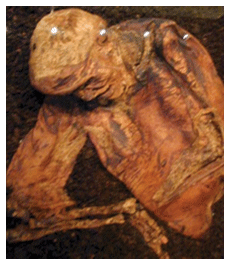
Lindow Man is a human male who lived in Britain during the late Iron Age and died approximately 2,000 years ago. His body was discovered in a peat bog near the village of Lindow in Cheshire, England in 1984.
The remains of Lindow Man were so well-preserved that scientists were able to reconstruct much of his life and death. Carbon dating and other techniques showed him to have been alive around the time of the Roman invasion of Britain in 43 AD. He was between 25 and 50 years old when he died.
Because of the excellent condition of the remains, scientists were able to determine that Lindow Man was of average height and had a muscular build. He had a broken arm, which indicates he may have been involved in a struggle prior to his death.
Analysis of the remains also revealed that he had suffered a number of wounds, including a fractured skull, a severed left arm, and a crushed rib cage. These injuries likely occurred shortly before his death, and it is believed that he may have been a victim of a ritual sacrifice.
In addition to the wounds, Lindow Man had a number oftattoos, piercings, and ritualistic cuts found on his body . These indicate that he was part of a religious or spiritual group and was likely involved in their ceremonies and rituals.
The discovery of Lindow Man has provided a unique glimpse into Iron Age life in Britain, and he continues to be studied by archaeologists today.
Archaeological Evidence Connected to Lindow Man :
Archaeological evidence connected to Lindow Man includes a variety of artifacts, remains, and other evidence that has been uncovered since his discovery in 1984. The most prominent evidence is the remains of Lindow Man himself. Found in a peat bog in Cheshire, England, his remains have been dated to the late Iron Age, around 200 BC. His body was remarkably preserved and is now one of the best-known archaeological finds from the Iron Age.
To the remains of Lindow Man himself, various artifacts were discovered at the site, including a hide cap, a leather belt, and a belt buckle. These items suggest that Lindow Man was of high status or was involved in ritual activities. Other artifacts found at the site include a spindle whorl, a piece of iron, and a piece of shale. These artifacts are believed to have been used in ritual activities, likely related to fertility or other religious ceremonies.
Other evidence that has been uncovered includes pollen and plant remains, which have helped to reconstruct the environment of the area at the time of Lindow Man's death. Pollen analysis has suggested that the area was heavily wooded, with oak and birch trees dominant. The presence of certain species of plants also suggests that the area was near a large body of water.
Finally, numerous pieces of evidence related to Lindow Man's death have been uncovered. This includes evidence of strangulation and blunt force trauma, suggesting that he was killed by a combination of these two methods. The presence of certain chemicals in his body has also indicated that he may have been poisoned before being killed.

Theories on the Cause of Death of Lindow Man :
- Lindow Man, also known as Lindow II and Pete Marsh, is the name given to a well-preserved Iron Age bog body, discovered in a peat bog at Lindow Moss near Wilmslow in Cheshire, England. He is believed to have died in the 1st century BC, making him one of the oldest bog bodies ever found. The cause of death has been the subject of debate for decades, and numerous theories have been proposed.
- One of the most popular theories is that Lindow Man was a human sacrifice. This theory is based on archaeological evidence from other Iron Age sites, which suggests that human sacrifice was practiced by some Iron Age people. According to this theory, Lindow Man was killed as part of a ritual offering to the gods, either as part of a fertility ritual or as a form of punishment.
- Another theory is that Lindow Man was killed as part of a judicial execution. This theory is based on the fact that Lindow Man's hands and feet appear to have been bound before he died. This suggests that he may have been killed as part of a punishment for a crime he had committed.
- A third theory is that Lindow Man was killed as part of a revenge killing. This theory suggests that Lindow Man was killed by someone who had a personal grudge against him, possibly a rival or an enemy of his tribe.
- Some have suggested that Lindow Man may have died as a result of an accident, such as drowning. This theory is based on the fact that his body was found in a bog, which could have been caused by his body being accidentally submerged in water.
- No matter which theory is correct, Lindow Man's death remains a mystery. His body is an important archaeological find, and his death is a reminder of the harsh realities of life in the Iron Age.
Archaeologists contributing to the Lindow Man Project

He is having leadership positions on Board of Directors, Davies ...

Hutton's books on paganism have received some criticism from certain ...
Analysis of the Lindow Man's Hair & Clothing :
The Lindow Man was discovered in 1984, preserved in a peat bog in Cheshire, England. He was originally dated around the second century CE, but recent carbon dating suggests he was likely alive between A.D. 50 and A.D. 100.
-
Hair :
The Lindow Man was found to have a full head of curly brown hair. His hair was neatly cut and combed, indicating he had a well-maintained personal appearance. It is possible that he used some type of oil or pomade to keep his hair tamed and in shape.
-
Clothing:
The Lindow Man was found wearing a woolen cloak or cape. It was likely made of two rectangular pieces of cloth, sewn together at the shoulders and at the sides. The fabric was likely dyed using plant-based dyes, as shown by the blue and yellow colors. The garment was secured with a leather belt and decorated with bronze studs. He was also wearing a pair of leather shoes, which were well-crafted and had decorative laces.
-
Necklace :
The Lindow Man was wearing a necklace of jet beads and an armlet of jet and bronze. Jet is a black stone that was popular in the Iron Age and was likely used as a symbol of wealth and status. His armlet would have been highly valuable and expensive, indicating he was likely a person of some social standing.
The clothing and jewelry of the Lindow Man provide us with insights into the Iron Age society in which he lived. His clothing suggests he was of some social standing, and his jewelry may have been a sign of his wealth and status. The careful attention to his personal grooming also suggests that he had a certain degree of sophistication and self-respect.
Books Related to Lindow Man
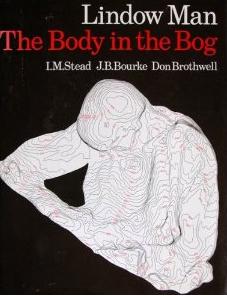
Lindow Man: The Body in the Bog by I.M. Stead,J. B. Bourke and Don R. Brothwell.
It was published by British Museum Publications in 1986 for the trustees of British Museum.
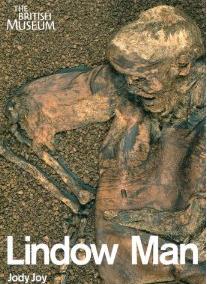
Lindow Man (People in Focus) by Jody Joy.
Lindow Manwas accidentally discovered by peat-cutters in Cheshire in the 1980s. He was first thought to be a modern murder victim, but scientific investigations soon proved that he had died in the first century AD, around the time of the Roman conquest of Britain.
Rich Resources over the web on Lindow Man
Lindow man
Lindow Man from England had been struck from behind on the head with an axe, struck in the back with such force that one of the ribs was broken, and then unconscious but still alive, he was garrotted with a cord tied around his neck.
Important archaeological Discoveries
Amesbury ArcherAmesbury Archer (or King of Stonehenge) is an early Bronze Age man, dating to around 2300 BC. His grave is of particular importance because of the rich valuables and the earliest gold objects ever found in England.
Otzi the Ice mummyOtzi the Iceman is well naturally preserved mummy of a man. The man who was been captured in Ice was believed to be over 53 centuries old (3300 BC).
Java ManJava man is an interesting discovery to note that the find was not a complete specimen, but consisted merely of a skullcap, a femur, and three teeth. Many scientists of the day even suggested that Dubois' Java Man might have been the so-called "
missing link
Kennewick ManKennewick Man is the name for the remains of a prehistoric man found on a bank of the Columbia River near Kennewick, Washington, on July 28, 1996. The Kennewick Man news story is one of the most significant archaeology stories of contemporary times.
Neanderthal ManNeandertal1 or Neanderthal was a species of genus Homo (Homo neanderthalensis) that inhabited Europe and parts of western Asia during the last ice age.
Peking ManPeking Man (sometimes now called Beijing Man), also called Sinanthropus pekinensis (currently Homo erectus pekinensis), is an example of Homo erectus.
Red lady of PavilandThe Red Lady of Paviland is a fairly complete Upper Paleolithic-era human male skeleton dyed in red ochre, discovered in 1823 by Rev. William Buckland in one of the Paviland limestone caves of the Gower Peninsula in south Wales, dating from c29,000.
Tollund ManThe Tollund man lived during the late 5th century BC and/or early 4th century BC, about 2,400 years . He was buried in a peat bog on the Jutland Peninsula in Denmark, a find known as a bog body.
Turkana BoyTurkana Boy, the designation given to fossil KNM-WT (Kenya National Museum-West Turkana), is a nearly complete skeleton of a 12-year-old hominid boy who died 1.6 million years ago.Turkana Boy is classified as either Homo erectus or Homo ergaster.
Dead Sea scrollsThe Dead Sea Scrolls are a collection of about 850 documents, including texts from the Hebrew Bible, which were discovered in eleven caves near Qumran, in a fortress northwest of the Dead Sea in Israel.
Narmer PaletteThe Narmer Palette, or Great Hierakonpolis Palette, is a significant Egyptian archeological find, dating from about 3200 BC, containing some of the earliest hieroglyphic inscriptions ever found, and depicting the unification of Upper and Lower Egypt under Narmer.
Rosetta StoneRosetta Stone is a dark granite stone (often incorrectly identified as "basalt") which provided modern researchers with translations of ancient text in Egyptian demotic script, Greek, and Egyptian hieroglyphics.
Linear BLinear B is the script that was used for writing Mycenaean, an early form of the Greek language. It occurrs primarily on tablets dated from the 14th and 13th centuries BC.
Sweet trackThe Sweet Track is an ancient roadway in the Somerset Levels, England. As of the early 2000s, it is the oldest known engineered roadway in the world. An grand footpath that ran for almost 2km across the Somerset levels swamps.
Tautavel ManTautavel Man is an ancestor of Neanderthal man, was slightly different from his contemporaries living Asia and Africa. In the village of Tautavel is located in the South of France, one of the most ancient humans was found: the Tautavel Man.
Galilee BoatThe
Galilee Boat which is also referred as the "Jesus Boat" was found by local
Galilean inhabitants in January 1986. The boat was wrapped in a polyurethane shell and then immersed in a special tank of water to avoid quick disintegration.
Ekron InscriptionThe monumental
Ekron inscription is dated, statistically and historically, to the first half of the seventh century B.C.E. The five lines of the inscription are together with this in a slit open border.
Pontius PilateIt wasn't long back when a lot of scholars were quizzical the real survival of a Roman Governor with the name Pontius Pilate, the procurator who ordered
Jesus' crucifixion. In June 1961 close to Caesarea-on-the-Sea (Maritima) was unearthed this appealing limestone block.
Ossuary of CaiaphasIn 1990 ornately decorate limestone ossuary (bone depository) was found in Jerusalem's Peace Forest. In the ossuary were the bones of two babies, a adolescent child, a teenage boy, an adult woman, and a man about 60years of age.
Baruch BullaIn
biblical Israel, papyrus was the main form of writing substance. Once an authorized deed was written, it would be rolled up, one end crinkled in one-third of the width and the contrary end likewise folded in.
Ugarit-Pre historic cityIt is the Capital city of a prehistoric principality in what these days is on the northern part of the Syrian coast, just north of the city of Latakia.